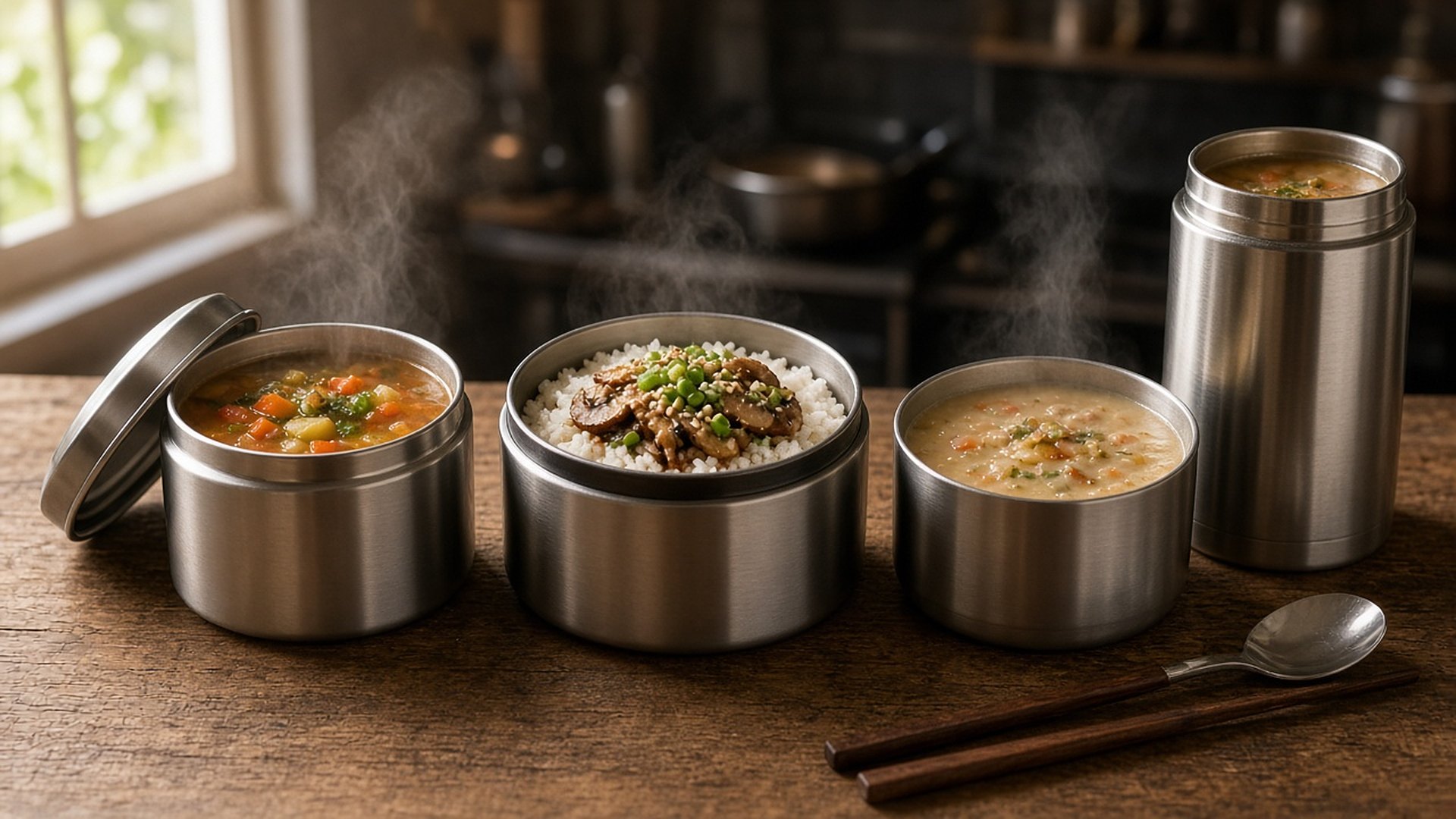
Insulated Food Jar for Lunch: Hot Food Without a Microwave
No microwave at the office, on the job site or at college? A good food jar keeps your meal prep hot for hours – if you use it right.
Disclosure: This article contains affiliate links. If you buy through them, we earn a commission – the price stays the same for you.
Meal prep often quietly assumes a microwave. But there isn't one everywhere: on job sites, in field jobs, at many schools, on day trips or in offices where there's a line at the one microwave at noon. An insulated food jar – also called a thermos or insulated container – solves that without electricity. You fill it hot in the morning and eat warm at lunch.
Sounds simple, and yet many people end up with lukewarm stew. It almost always comes down to three things: not preheated, not filled hot enough, jar half empty. Here's how to do it right and which jar suits you.
How does an insulated food jar work?
Good models consist of two stainless steel walls with a vacuum in between. Without air, hardly any heat can escape. The lid is the weak point – that's why wide, well-insulated lids with a seal matter. Manufacturer heat retention figures usually refer to a preheated, full jar. In real life the numbers are often a bit lower.
How to keep your food really hot
- Preheat: fill the jar with boiling water, lid on, let it sit five to ten minutes. Pour out the water.
- Heat food properly: heat your prepped meal in a pot or microwave until bubbling hot – not just "warm".
- Fill it up: the less air in the jar, the longer it stays hot. A half-full 17 oz jar cools faster than a full 12 oz jar.
- Close immediately: don't let it steam off with the lid open.
- Don't keep opening it: every peek costs heat.
Important for food safety: food kept hot should stay above 140 °F (60 °C). If your jar can't manage that until lunch, eat earlier, use a smaller jar filled to the top – or pack the food chilled and reheat it on site. Lukewarm for hours is the worst combination.
Which size fits?
| Volume (approx.) | Good for | Note |
|---|---|---|
| 10–14 oz (300–400 ml) | kids, light appetite, side or soup as a starter | stays hot longest when full |
| 16–20 oz (450–600 ml) | a normal adult lunch | the all-rounder for office and college |
| 24–34 oz (700 ml–1 L) | big appetite, physical work, two portions | only makes sense if you fill it up |
What works – and what doesn't?
Ideal
- soups, stews, chili, curries, dal
- risotto, rice pudding, porridge
- pasta in sauce (cook slightly al dente, it keeps softening)
- rice with sauce or a vegetable stir-fry with sauce
Less good
- anything crispy – it goes soft in a closed jar
- dry rice without sauce – it cools quickly and clumps
- fish or strong-smelling dishes, if you open it in an open-plan office
Tip: pack toppings separately. Croutons, nuts, herbs or yogurt go into a small extra container and only get added when you eat. Which mini containers work is covered in our guide to sauce and spice containers.
For cold food too
Food jars don't just keep things warm. Pre-chilled with cold water or a few ice cubes, yogurt with fruit, overnight oats or pasta salad stay fresh longer in summer. Handy for days without a fridge.
Buying criteria
- Double-walled vacuum stainless steel: the heart of it. Single-walled containers barely keep warm.
- Wide mouth: easier to fill, eat from and clean.
- Seal and leak protection: important when the jar is in your backpack.
- Food-grade stainless steel: often listed as 18/8, flavor-neutral.
- Dishwasher: many manufacturers recommend handwashing so the vacuum lasts – check before buying.
- Folding spoon in the lid: nice, but not a must.
And don't forget: a food jar never goes in the microwave. Heat beforehand, in a pot or a microwave-safe container.
Our picks
We link to Amazon search results instead of individual products – that way you see current prices, sizes and reviews and choose for yourself. Prices and availability may change.
- Food jar approx. 16 oz (500 ml) double-walled, stainless steel, wide mouth
The all-rounder for a normal lunch at the office or college.
- Large food jar approx. 25–34 oz (750 ml–1 L) for a big appetite or stews
Makes sense for physical work – but only when filled up.
- Food jar for kids approx. 10–12 oz (300–350 ml), compact
Small portion, stays warm especially long when full.
FAQ
How long does an insulated food jar keep food hot?
Several hours, depending on the model, preheating and fill level. Manufacturer figures usually apply to preheated, full jars – in everyday use it's often a bit less.
Do I need to preheat a food jar?
Yes, it's the most important step. Fill with boiling water for five to ten minutes, pour it out and immediately add the hot food.
What size makes sense for adults?
For a normal lunch, usually 16–20 oz (450–600 ml). Bigger only if you actually fill it.
Can a food jar go in the microwave?
No. Stainless steel doesn't belong in the microwave. Heat the food first, then fill.
Can I take cold food in a food jar too?
Yes. Pre-chilled with cold water or ice cubes, yogurt, oats or salads stay cool longer.
Keep reading
- Lunchbox mistakes that make food soggy
- Sauce and spice containers for meal prep
- Freezing meal prep: keep cooked food tasting great
Disclosure / affiliate: This article contains affiliate links. As an Amazon Associate we earn from qualifying purchases. The price you pay stays the same. Assessments are based on manufacturer specs and everyday use (as of October 2026).